
A framework for next generation category management: three phases that actually work
Category management frameworks have existed for decades. Most describe what should happen: assess the category, develop a strategy, align with the retailer, execute. What they rarely address is why the sequence breaks down in practice, and which single missing element causes most of the failure.
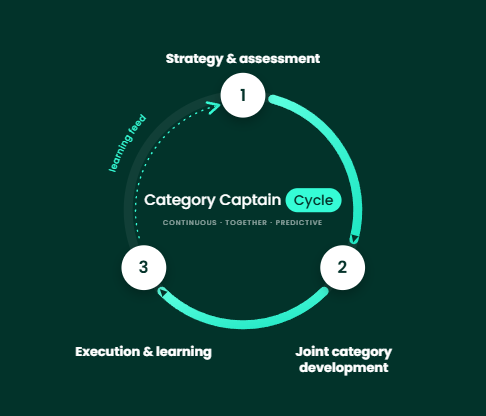
The next generation category management framework is not a linear process. It is a continuous cycle. Three phases that keep turning: strategy and assessment, joint category development, and execution and learning. The output of phase three feeds directly back into phase one. The loop never closes because the category never stands still.
What makes this cycle possible is a data foundation that runs continuously beneath all three phases. Not a preparatory step, but the engine that keeps the cycle moving. This article explains the framework, how each phase works, and what changes when AI powers the cycle. It connects to our broader articles on agentic category management and the next generation of category management.

What is the next generation category management framework?
The next generation category management framework is a continuous cycle of three phases: Strategy and Assessment, Joint Category Development, and Execution and Learning. Unlike the traditional eight step model, it does not have a start and an end. Every cycle of execution produces learning that feeds back into strategy. The framework is continuous, collaborative and predictive.
The three phases of the cycle at a glance:
Phase 1: Strategy and Assessment. Continuous insights, real time signals, and strategy built around the Most Valuable Shopper Segment.
Phase 2: Joint Category Development. Collaborative planning with the retailer, built on one shared truth instead of competing versions of the data.
Phase 3: Execution and Learning. Predictive tools for promotion, assortment and pricing, with real time monitoring and every outcome feeding back into phase 1.
Beneath all three phases runs the data foundation: a continuously updated, harmonized dataset that makes the cycle possible. Without it, the cycle slows down, the phases become disconnected, and the framework collapses back into the old quarterly reporting model.
The data foundation: the engine beneath the cycle
The data foundation is not a phase. It is the infrastructure that makes all three phases work. All retail sources, POS data from retailer platforms like SIS and 7EVEN, syndicated data from Nielsen and Circana, pricing and promotion data, and internal sales data, harmonized into one consistent truth, updated continuously.
EAN changes are processed automatically so historical trend lines stay intact. The data is always current, always complete, and always structured in the way the AI agent needs to run reliable analysis. When a team member asks a question, the agent does not gather data first. The data is already there.
The consequence of not having this foundation is that 60% of category team capacity goes to data preparation rather than category management. Teams spend their time matching, cleaning and consolidating before any analysis is possible. The cycle stalls before it starts. Read more in our article on data harmonization in retail.
Phase 1: Strategy and Assessment
Strategy and Assessment is where the cycle begins and where it returns after every execution phase. It is the intelligence layer: what is happening in the category, who is driving it, and where is the opportunity?
Continuous insights instead of periodic reviews
In the old model, strategy is developed once a year in preparation for the joint business planning meeting. By the time the plan is presented, the market has moved. In the next generation framework, strategy and assessment is continuous. The AI agent monitors category performance in near real time, surfaces signals as they emerge, and answers strategic questions in minutes instead of weeks.
A category manager asks: how is the promotional pressure in the dairy category developing compared to last quarter? The agent retrieves the analysis from the harmonized data foundation, applies the right methodology and delivers an answer the category manager can bring to the next retailer conversation. No manual data gathering. No waiting for the next quarterly review.
The Most Valuable Shopper Segment
The central strategic concept in phase 1 is the Most Valuable Shopper Segment. Research consistently shows that approximately 70% of category sales come from a relatively small shopper segment. Planning a category for the average shopper dilutes the strategy. Planning it for the segment that drives the vast majority of value creates a sharper proposition for the retailer and more profitable outcomes for both parties.
Identifying the Most Valuable Shopper Segment requires store-level data enriched with shopper profile information: household composition, income level, purchase behavior in the category. In the MAAZ Cheese case, this analysis revealed that luxury cheese SKUs sold out in Wassenaar while collecting dust in student neighborhoods in Leiden. The assortment strategy that followed was specific to each store cluster, not a generic market average. Read more in our article on AI in retail analytics.
Predictive analytics and competitive benchmarking
Phase 1 in the next generation framework looks forward, not backward. Predictive analytics identifies which SKUs are gaining momentum before the trend shows up in a quarterly report. Competitive benchmarking maps where the category is being won and lost across retailers. The goal is to move from gut feel to fact-based decision making, arriving at phase 2 with a strategic position that is grounded in data the retailer can verify. Read more in our article on predictive retail analytics.
Phase 2: Joint Category Development
Phase 2 is where strategy becomes collaboration. Joint Category Development is the model where supplier and retailer work from the same data toward shared category goals. Not a supplier presenting a plan and a retailer accepting or rejecting it. A genuine joint process where both parties contribute their data and their expertise.
One shared truth at the table
The most common failure mode in retailer collaboration is the data discussion. The supplier arrives with their numbers. The retailer has different numbers. The meeting becomes a debate about whose data is right instead of a conversation about what to do. The next generation framework eliminates that failure mode by establishing one shared truth before the conversation begins. Read more in our article on Joint Category Development.
Category reviews, shelf advice and promotion evaluations are prepared from that shared foundation. The retailer recognizes the data because it comes from their own sources, harmonized and combined with the supplier's cross-retailer perspective. The conversation starts at the content, not at the numbers.
Scenario planning and forecasting
Phase 2 in the next generation framework is powered by scenario planning and forecasting. Instead of agreeing on a promotion and hoping it performs, the supplier arrives with a model showing projected outcomes under different scenarios. What happens to category margin if the promotion depth is reduced by 5%? What is the cannibalization risk across adjacent SKUs? What is the expected velocity impact of adding a new SKU to a specific store cluster? That is the shift from reactive alignment to proactive joint decision making. Read more in our article on trade promotion forecasting.
Phase 3: Execution and Learning
Phase 3 is where plans become results. And where results become the input for the next cycle. Execution in the next generation framework is not a separate activity that happens after planning is complete. It is continuous, monitored in near real time, and every outcome feeds back into phase 1.
Predictive tools for assortment, promotion and pricing
The promo simulator models promotion impact per SKU before the promotion is agreed, based on price elasticity calculated from actual historical sell-out data. Assortment optimization identifies per store cluster which SKUs should be added or removed to improve category revenue and margin. Pricing strategy is grounded in elasticity models that show exactly where a price movement creates value and where it destroys it.
These are not backward-looking reports. They are forward looking tools that give the supplier the analytical depth to make recommendations the retailer cannot generate alone. That is the cross-retailer perspective that makes the supplier relevant at the category table. Read more in our article on AI in category management.
Real-time monitoring
Once a promotion is running or an assortment change is implemented, the agentic AI layer monitors performance in near real time. Instead of waiting for a monthly report to discover that a promotion is underperforming, the agent surfaces the signal in week two, when there is still time to act. Instead of discovering in a quarterly review that a competitor has expanded distribution in a key cluster, the system flags the trend as it emerges.
Having a human in the loop remains essential throughout. The agent surfaces the signal and prepares the recommendation. The category manager applies judgment and makes the call. Data quality is the foundation of all of this.
Every outcome feeds back into phase 1
The defining feature of the next generation framework is that the cycle does not have an end. Every execution outcome, every promotion result, every assortment change, every real-time signal, feeds back into phase 1 as new learning. The strategy gets sharper with every cycle. The predictions get more accurate. The retailer conversation gets more grounded. The cycle turns continuously, and every turn makes the next one better.
From the old model to the continuous cycle
The contrast with the traditional eight step model is stark. The old model is a line with an end point: assess, plan, execute, review, and start again next year. In a quarterly cadence, the category manager spends most of Q1 gathering data, most of Q2 building the plan, most of Q3 executing, and most of Q4 preparing for the next year's joint business planning meeting. The category is always one quarter behind.
The next generation framework runs continuously. Strategy and assessment never stops. Joint Category Development happens in real time as insights emerge, not once a year in a formal planning cycle. Execution is monitored daily, not reviewed quarterly. And every cycle of learning feeds immediately back into the next cycle of strategy.
The data power gap between supplier and retailer is growing. Retailers are building AI capabilities on their own data and making category decisions faster and with less dependence on supplier input. The suppliers who close that gap by running the continuous category management cycle are the ones who remain relevant. Those who stay on the old model deliver information the retailer already has. Read more in our article on the data power gap between supplier and retailer.
How Captain runs the cycle
Captain is built to power all three phases of the continuous category management cycle, starting with the data foundation that makes the cycle possible.
The data foundation harmonizes all retail sources automatically. EAN changes are processed without breaking historical trend lines. The data is always current and always in the form the AI agent needs.
Phase 1: the AI agent monitors category performance continuously, surfaces signals proactively, identifies the Most Valuable Shopper Segment per category, and answers strategic questions in minutes. The category manager spends their time on strategy, not on data gathering.
Phase 2: category reviews, retailer stories and promotion evaluations are prepared from the shared data foundation. The retailer recognizes the data. The conversation starts at the content. Scenario planning and forecasting give both parties the confidence to make decisions based on projected outcomes, not historical averages.
Phase 3: the promo simulator, assortment optimization and pricing tools give the supplier the analytical depth to make forward-looking recommendations. Real-time monitoring surfaces deviations before they cost margin. Every outcome feeds back into phase 1 automatically.
At Johma, this cycle produced a promotional plan that Albert Heijn adopted, shifting the promotion to week 35 for 21% more uplift and a €60K opportunity. At MAAZ Cheese, store-cluster specific assortment optimization resulted in 4% category growth and 7% less waste. At Elho, the team went from covering half of their retailer conversations with the right plans to all of them.
Ready to start the cycle?
Want to see what the continuous category management cycle looks like applied to your own retail data and category? Request a demo and come away with a practical view of where your team currently sits and what the next step looks like.

Article written by
Guus van Heijningen
Frequently asked questions
What are the three phases of the next generation category management framework?
The three phases are Strategy and Assessment, Joint Category Development, and Execution and Learning. They form a continuous cycle: every execution outcome feeds back into strategy, every strategic insight informs the joint plan, every joint plan drives the execution. The cycle never ends because the category never stands still. Beneath all three phases runs a continuously updated data foundation.
What is a next generation category management framework?
The next generation category management framework is a continuous cycle of three phases that replaces the traditional linear eight step model. Where the old model had a start and an end, the new framework runs continuously: strategy informs collaboration, collaboration drives execution, and execution feeds back into strategy. It is powered by AI and grounded in one shared data foundation that both supplier and retailer can trust.
Why is the traditional eight-step category management model no longer sufficient?
The traditional eight step model was designed for a world of annual reviews, manual analysis and quarterly cadences. A category plan that takes months to build arrives already outdated. Retailers now make category decisions faster, with more data and less dependence on supplier input. The continuous cycle framework operates at the speed the modern market requires, with near real time monitoring and AI driven insights that are always current.
What is the Most Valuable Shopper Segment in category management?
The Most Valuable Shopper Segment is the shopper group that drives approximately 70% of category sales. Next generation category management builds strategy around this specific segment rather than planning for the average shopper. Identifying it requires store-level data enriched with shopper profile information. In the MAAZ Cheese case, this analysis produced store cluster specific assortment recommendations that resulted in 4% category growth and 7% less waste.
How does agentic AI power the continuous category management cycle?
In phase 1, the AI agent monitors category performance continuously and surfaces strategic signals before they appear in standard reports. In phase 2, it prepares retailer stories and scenario models from the shared data foundation. In phase 3, the promo simulator, assortment optimization and real-time monitoring give the supplier forward looking analytical depth. Every outcome automatically feeds back into phase 1. The human in the loop, the category manager, applies judgment at each phase and makes the strategic calls. Read more in our article on agentic category management.
Related posts
%20Category%20Management%20in%20FMCG.jpg)
Agent to Agent (A2A) Category Management in FMCG
Agent to Agent (A2A) Category Management in FMCG

Agentic AI in retail: what it means for category management teams
Agentic AI in retail: what it means for category management teams

The next generation of category management: what AI changes
The next generation of category management: what AI changes