
The analytics maturity model for FMCG suppliers: from reporting to predictive AI
Retailers are already using predictive and prescriptive analytics to optimize promotions, assortments and pricing decisions at SKU level. Most FMCG suppliers are still building backward looking reports in Excel.
That gap is not a technology problem. It is an analytics maturity problem. Retailers own transaction level shopper data, basket composition and store-level demand patterns. Suppliers usually do not. That gives retailers a structural advantage in AI driven category management, unless suppliers improve their own data foundation and cross-retailer intelligence capabilities.
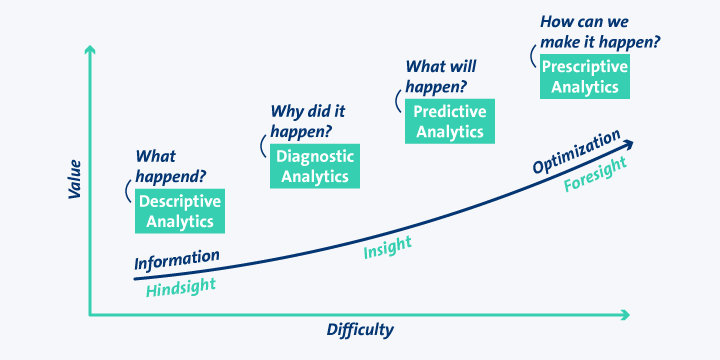
The analytics maturity model describes four phases. Most FMCG suppliers sit in phase one or two. Retailers are in three and four. This article explains what each phase means, why moving forward is now urgent, and what a unified data foundation makes possible. It connects directly to the data power gap between supplier and retailer that is reshaping how Joint Category Development works.

The four phases of the analytics maturity model
Each phase answers a different question and delivers a different level of value. Difficulty increases with each phase. So does competitive advantage.
Phase 1. Descriptive analytics: what happened?
Descriptive analytics looks backward. Sales last week. Best-performing products last month. How a promotion compared to the previous one.
This is where most FMCG supplier category teams operate. They export data from retailer platforms like SIS or 7EVEN, combine it with syndicated data from Nielsen or Circana, manually correct errors, and build a report. That process consumes an average of 60% of available time. What remains is not enough for the next step.
Phase 2. Diagnostic analytics: why did it happen?
Diagnostic analytics explains causality. Why did the velocity of this SKU drop in week 12? Was it the price increase, a competitor promotion, or a shelf issue?
This gives suppliers the grounding to explain what happened in a retailer meeting. But it still looks backward. The decision that should have been made in week 12 can no longer be made.
Phase 3. Predictive analytics: what will happen?
Predictive analytics looks forward. It uses historical patterns to forecast outcomes.
What is the expected impact of this promotion on category revenue? Which stores face the highest risk of a stockout? What is the price elasticity of this SKU at a 5% increase?
This is the phase most retailers already operate in. Suppliers who can only offer descriptive and diagnostic analysis are contributing less and less to this conversation.
Phase 4. Prescriptive analytics: what should we do now?
Predictive analytics forecasts outcomes. Prescriptive analytics recommends actions.
Not a general recommendation, but a specific one: add SKU X to the assortment of store cluster Y, because velocity in comparable clusters is 40% above the category average. Or: reduce the promotion frequency of SKU Z in region W, because price elasticity shows margin erosion is not compensated by volume growth.
Prescriptive analytics combines AI pattern recognition with human category expertise. The AI identifies patterns invisible at this data scale. The category manager evaluates the recommendation, applies context the data does not contain, and decides how to act.
Why predictive analytics matters in FMCG category management
Retailers invest heavily in AI tools that make predictive and prescriptive retail analytics possible at scale. They optimize assortments per store cluster, model promotions on price elasticity per SKU, and align inventory with store-specific demand patterns.
They do this faster than a supplier can compile a report.
For FMCG suppliers, this creates a fundamental choice. Stay in phases 1 and 2, and you deliver information the retailer already has or can generate faster on their own. Move into phases 3 and 4, and you contribute something the retailer does not have: cross-retailer perspective, product expertise and market intelligence combined with predictive analysis.
Industry research from more than a decade ago already projected that suppliers and retailers moving into prescriptive analytics could raise same-store sales by 2 to 5%. That projection has become reality. The question is no longer whether this matters. It is whether your team has the data foundation to act on it.
Where most FMCG suppliers stand today
Primarily in phase one, with excursions into phase two.
The structural cause is not a lack of ambition or talent. It is a lack of time and a unified data foundation. When 60% of available time goes to gathering, cleaning and harmonizing data, there is structurally too little capacity for predictive analysis.
The data required for reliable forecasting models, a complete and consistent data history per SKU per retailer, is not available in most organizations in the form that AI models need. Every break in the data history, from an EAN change not correctly processed or a restatement manually entered, weakens the forecasting model.
Meanwhile, retailers own roughly 60% of the relevant data in the value chain. Suppliers own around 20%. When retailers combine that 60% with powerful AI tools, while suppliers remain in phases 1 and 2, the gap becomes not just technical but strategic.
What suppliers need for predictive analytics
A unified data foundation
Predictive analytics requires a unified data foundation: all retail sources harmonized against a single product model, EAN changes processed automatically so trend lines stay intact, and a data history long enough for AI models to recognize patterns. Data harmonization is the prerequisite. Without it, forecasting models produce unreliable outputs.
Near real-time visibility across all retail accounts
A unified data foundation that is updated weekly is not enough for predictive analytics. The signals that matter, a velocity drop at a specific retailer, a promotion that is underperforming in week two, appear in near real-time data. Acting on them requires visibility that a manual reporting cycle cannot provide.
AI models that work on clean, structured data
AI models for price elasticity, promotion forecasting and assortment optimization require data that is clean, consistently structured and rich in context. A promotion result without the context of what else happened that week, a competitor price change, a seasonal event, is a data point an AI model cannot reliably learn from. Having a human in the loop remains essential throughout. AI in category management delivers value only when the data foundation beneath it is solid.
How Captain helps suppliers move up the maturity curve
Captain is built to give FMCG suppliers the analytical capability needed to remain relevant in a world where retailers already operate in phases 3 and 4.
The platform automatically harmonizes all retail sources against a single consistent product model. EAN changes are processed automatically. Restatements are handled without manual intervention. The unified data foundation is always current and complete enough for the AI models that make predictive and prescriptive analysis possible.
The promo simulator calculates promotion impact based on price elasticity per SKU, before the promotion is agreed. The assortment optimization identifies per store cluster which SKUs should be added or removed to improve category revenue and margin.
At Johma, prescriptive promotion analysis produced a plan adopted directly by Hoogvliet, Vomar and Plus. At MAAZ Cheese, assortment optimization based on POS data resulted in 9.4% margin improvement. At Elho, data backed category plans grew from 10 to 25+. Those are the results of suppliers that made the move into phases 3 and 4.
See how FMCG suppliers are moving from reporting to predictive category management
Request a demo to see how Captain helps your team build the unified data foundation for predictive and prescriptive analytics, and come away with practical tips for your specific situation.

Article written by
Frequently asked questions about the analytics maturity model
What is the analytics maturity model?
The analytics maturity model describes four phases organizations move through as their data capability develops: descriptive analytics (what happened?), diagnostic analytics (why did it happen?), predictive analytics (what will happen?) and prescriptive analytics (which action delivers the most value now?). Each phase builds on the previous one. The Gartner framework is the most widely referenced version of this model.
What is the difference between predictive and prescriptive analytics?
Predictive analytics forecasts outcomes. Prescriptive analytics recommends actions. Predictive tells you a promotion is likely to underperform. Prescriptive tells you which specific change, to which SKU, in which store cluster, will improve the result. For FMCG suppliers, prescriptive analytics is where the real competitive advantage lies.
Which analytics phase are most FMCG suppliers in?
Most FMCG suppliers operate in phases 1 and 2: descriptive and diagnostic analytics. The move into phase 3 and 4 is blocked by the fact that 60% of available time goes to manually harmonizing data. Without a unified data foundation, there is structurally too little capacity for predictive or prescriptive analytics.
Why is predictive analytics urgent for FMCG suppliers right now?
Retailers are already using predictive and prescriptive retail analytics at scale. They make category decisions faster, with more data, and with less need for supplier input. Suppliers who remain in phases 1 and 2 are delivering information the retailer already has. The supplier that reaches phases 3 and 4 contributes cross-retailer perspective and product expertise that the retailer cannot generate alone.
What does a supplier need to apply predictive analytics in category management?
A unified data foundation: all retail sources harmonized against a single consistent product model, EAN changes processed automatically, and a data history long enough for AI models to recognize patterns. Without that foundation, forecasting models produce unreliable outputs regardless of how sophisticated the AI is.
Related posts

Joint Category Development: the model that fixes how FMCG and retail work together
Joint Category Development: the model that fixes how FMCG and retail work together

Agentic AI in retail: what it means for category management teams
Agentic AI in retail: what it means for category management teams

Data harmonization in retail: how to handle inconsistent categorizations across your data sources
Data harmonization in retail: how to handle inconsistent categorizations across your data sources